
Some of the articles on Casa Diem Life may contain affiliate links. If you click and make a purchase, I might earn a small commission at no extra cost to you. It's just one way we keep the journey going! Find out more in my Privacy Policy.
“Global decor” is having a moment as travel becomes more accessible. But there’s a fine line between collecting inspiration and turning your home into a souvenir shop. To really nail the global decor aesthetic, skip the obvious (fridge magnets or tchotchkeys on the mantle) and select story objects: items that reflect places from your point of view.
The goal is a home that looks collected, layered with stories, texture, and time, not a home that screams, “I went to Morocco once!” No shade. Morocco is iconic. But you get me. I touched on this in Global Decor: How To Bring Travel Home (The Right Way).
Here are seven elevated items that do the heavy lifting when you’re curating the global decor aesthetic.
1) A textile fragment framed like art (not hung like fabric)
Fabrics are the cheat code. Elevated decor always uses texture to elicit emotions, and the easiest way to do so is to find textured pillows and throws for your home. However, we don’t take the easy route – pillows are not talking points. Art is.
Look for a textile fragment with age, for example, a vintage suzani panel (a hand-embroidered tapestry from Central Asia), a batik fragment, or mudcloth with real wear. Then frame it behind glass like a print.
Why it works:
- It reads gallery, not boho aisle.
- It adds pattern without taking over the room.
- It introduces craftsmanship and cultural richness in a respectful, grounded way.
How to style it:
- Choose one large or two medium pieces rather than a collage of small bits.
- Use a wide mat for breathing room so it immediately feels more “collected.”
- Hang it anywhere art would go, like above a sideboard, in a hallway, or in a bedroom.
You might be interested in How To Decorate With Global Textiles for a Travel – Inspired Space.
2) A hand-carved wooden stool that can’t decide if it’s furniture or Art
Every global home needs one object that looks like it was made by hand, not machines.
A hand-carved stool (think: African-inspired, primitive Scandinavian, wabi-sabi, or old-French milking-stool vibes) works because it’s a functional sculpture. It tells a story even when it’s doing nothing.
Why it works:
- Wood adds warmth and age instantly.
- The imperfect shape reads authentic and human.
- It’s versatile: I love items that serve multiple purposes because an uncluttered home gives your style room to breathe.
How to style it:
- Keep it near sleek upholstery, such as a linen sofa or a modern chair, for contrast.
- If you can’t bear to leave surfaces bare, put one simple object on top, such as a stone bowl, a book, or a small candle. Don’t clutter it.
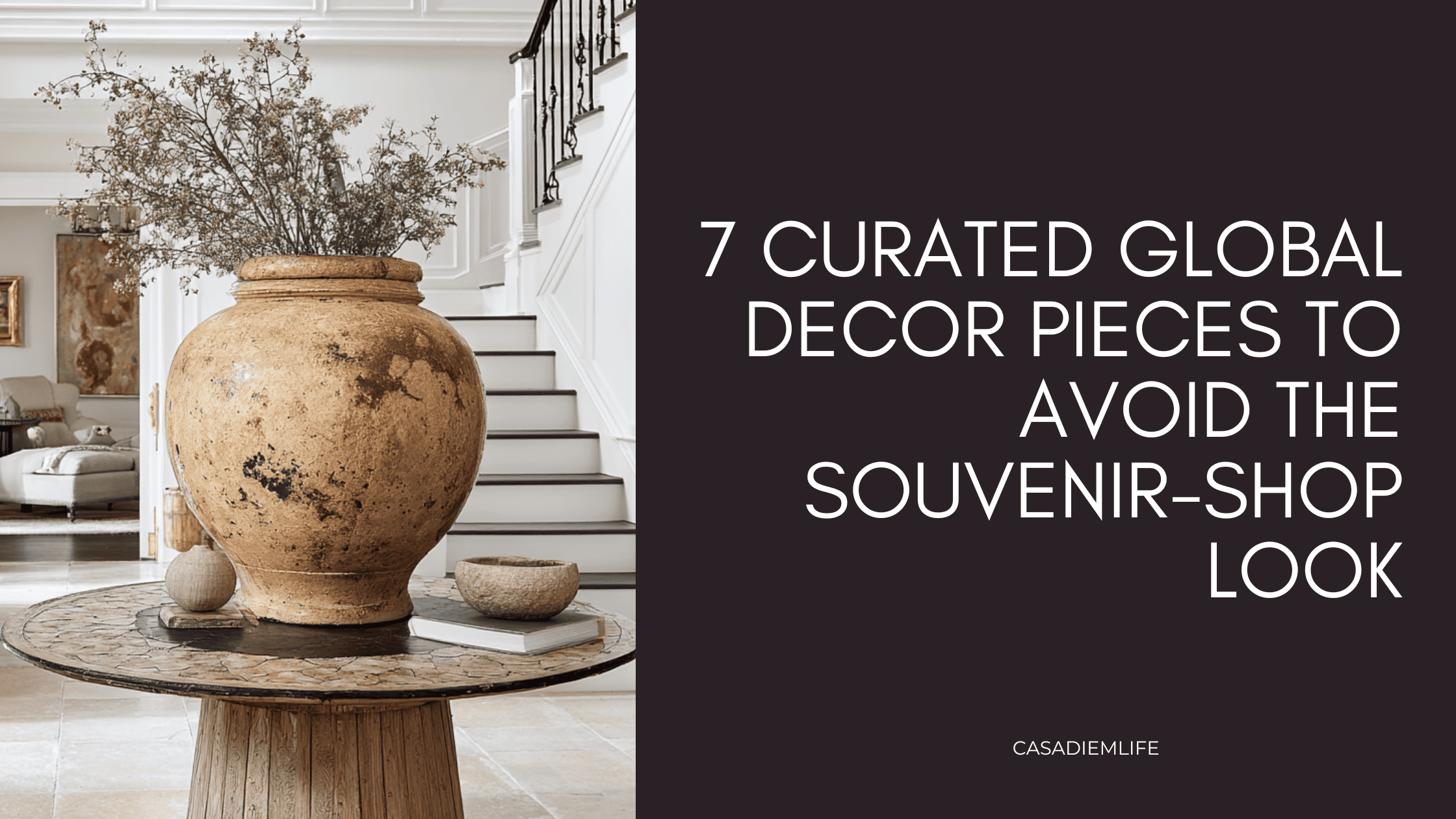
3) One oversized vessel that looks like it once had a job
In truly global homes, vessels aren’t “decor.” They were tools for water, grain, oil, fermentation, and storage.
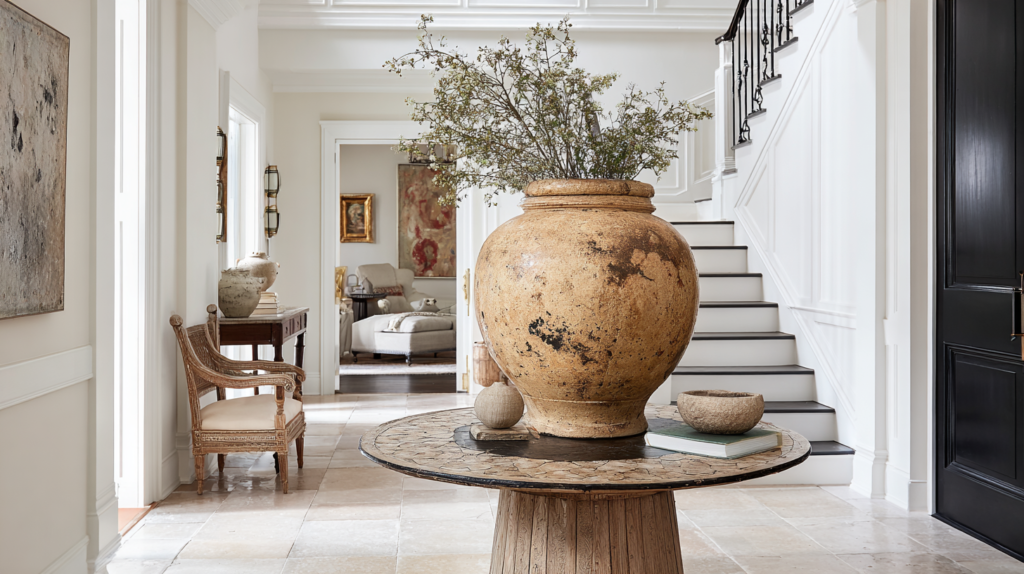
Look for an oversized terracotta jar, an antique olive urn, a wooden dough bowl, a stone mortar, or even a large woven storage basket with a strong shape. The key is: it should feel like it did something before retiring to your home.
Why it works:
- Scale creates instant drama.
- It adds earthiness and texture without needing a pattern.
- It feels timeless (because it is).
How to style it:
- Let it sit empty. Yes, empty. That’s luxury.
- If you do need to add something to balance your space, aim for structural, not fussy. I would recommend tall branches, dried palms, or eucalyptus (sparingly).
4) A patina’d metal “anchor” piece
The global decor aesthetic shies away from shiny, brand-new finishes. We’re looking for metal with history, like brass, bronze, copper, and iron, with a finish that suggests it’s been handled.
A large tray or low platter is especially powerful because it becomes a platform for your layer and can be repeated throughout the home without being overdone.
Why it works:
- Patina adds age and credibility to a space fast.
- Metal balances all the softness of textiles and wood.
- It adds a subtle glow in candlelight (hello, evening mood).
How to style it:
- Use it on a coffee table or console with only 2–3 styling items.
- Don’t over-style. Let the finish speak.
5) A piece of architectural salvage (the grown-up flex)
This is where global decor gets serious.
Architectural salvage, like an old corbel, carved panel, antique door fragment, or reclaimed beam, evokes a sense of travel because it’s literally a piece of another structure.
Why it works:
- It adds gravitas. It’s the difference between “inspired by” and “collected.”
- It’s a focal point without being loud.
- It introduces craftsmanship on a bigger scale than most decor items.
How to style it:
- Lean a carved panel against the wall on a console.
- Mount corbels as sculptural brackets (even if they hold nothing).
- Use a reclaimed wood beam as a mantel moment (even in a modern house).
6) A shadowbox of travel mementos (but make it minimal)
This one is for the sentimental amongst us. If global decor is a story, let your home show receipts quietly.
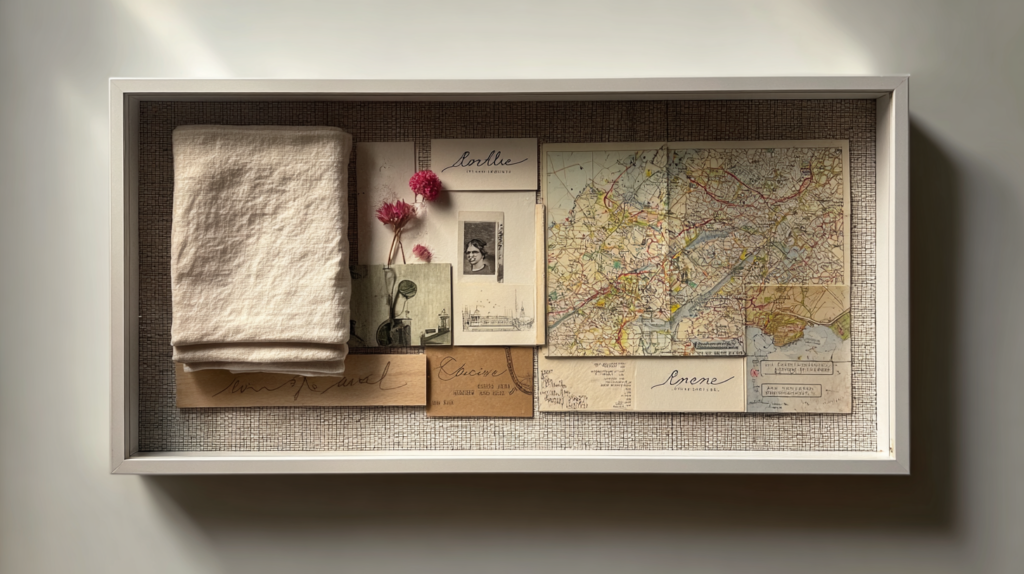
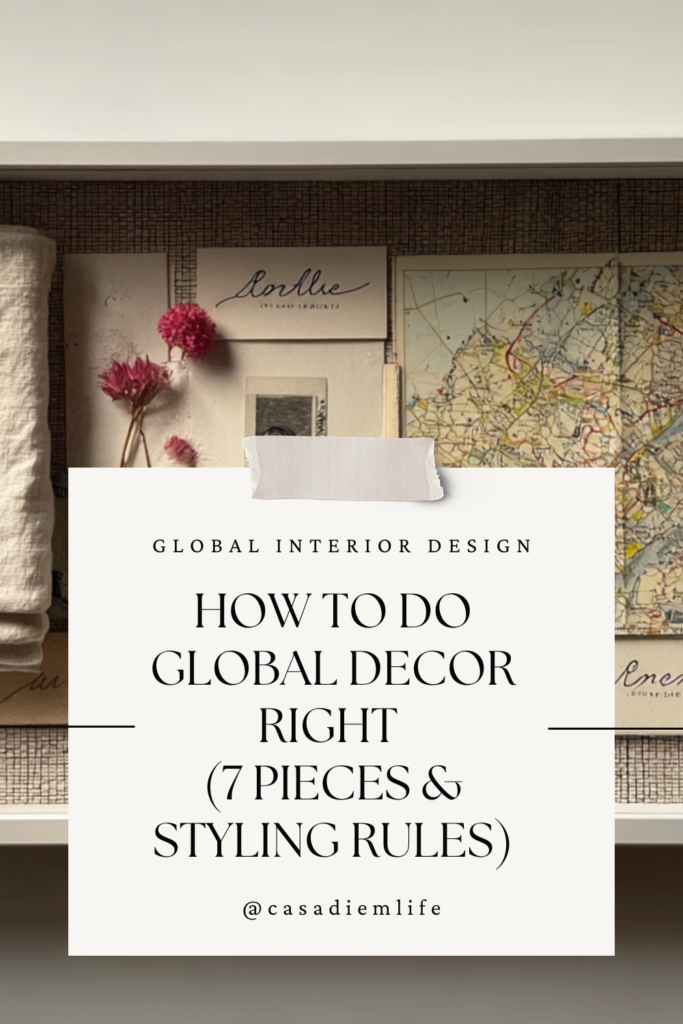
A shadowbox (or deep frame) with a few meaningful pieces, like a museum ticket, a handwritten note, a tiny map excerpt, or a pressed leaf, can feel intimate, not touristy, if you edit like a curator.
Use your shadowbox to freeze a moment, not highlight an entire trip. For example, if you’re capturing a romantic night in Paris, edit out the plane ticket, the hotel key card, and anything that makes it feel like a full itinerary.
Instead, curate a few quiet details: a small set of wooden letters spelling the restaurant’s name, a clipped map excerpt with the Eiffel Tower circled, and one tactile piece like a wine label so the memory feels intimate, not crowded.
Why it works:
- It personalizes the “global” part (because it’s actually yours).
- It adds detail and soul without adding clutter.
- It’s a conversation starter that isn’t performative.
How to style it:
- Limit it to 5–7 items max.
- Choose a neutral backing (linen, matte paper, soft black).
- Keep the frame simple. The artifacts are the art.
If you want to add a lot more nuance to your home, read Why Your Home Doesn’t Feel Special, And What To Do About It.
7) One “maker mark” piece: an object with visible imperfections
This is the opposite of mass-produced “global decor.”
What you’re seeking are pieces that signal: a human made this. Asymmetry, visible imperfections, fixed breaks, raw wooden edges, and unpolished stones looked like they had been handled by someone with a passion for creating.
It doesn’t have to be a loud or jarring imperfection. Consider a handmade ceramic bowl with slight warping, a woven object with irregular stitches, or a hand-thrown vase with fingerprints in the glaze.
Why it works:
- It adds authenticity without needing cultural symbols.
- It’s timeless because it doesn’t belong to a trend cycle.
- It layers beautifully with every design aesthetic.
How to style it:
- Keep it in the places you touch, like your entry table, nightstand, or kitchen counter.
- Let it be something functional like a key hook, fruit basket, salt cellar, or jewelry dish.
How To Make These Seven Global Decor Items Look Intentional
If you buy all seven and scatter them, you’ll still miss the mark. The magic is in repetition and restraint.
Use these three rules:
1) Repeat materials, not motifs.
Repeat wood tones, aged metals, and textures. Don’t repeat tribal prints or loud patterns.
2) Choose one hero, then support it.
If your hero is the framed textile, let the rest be quieter: If your hero is the salvage panel, keep art minimal elsewhere.
3) Leave negative space.
Global decor looks expensive when it has room to breathe. The pause is part of the design.
A gentle reminder – because we do global decor with respect here
Global decor should honor craftsmanship and culture, not reduce it to trendy props. If you’re pulling from a culture, prioritize:
- artisan-made pieces (pay people),
- vintage/secondhand sourcing (value sustainability),
- learning the story behind what you buy (increase cultural awareness and sensitivity),
- avoiding sacred symbols as “aesthetic” (at all costs).
A home can be globally inspired and deeply respectful. That’s the goal.
Feeling inspired? Pin it for later!
Want the 'how' after the inspiration?
The WanderHome newsletter is where you'll find more in-depth guides, design notes, and a few life updates to help daily life feel a little softer.
I'll send my Home Health Checklist to help you pinpoint what already works and what's quietly causing you stress in your home.

Hi, I’m Chioma — a spirited explorer and interior designer with a soft spot for a full table. I help travel-lovers bring that vacation feeling home through travel-inspired design, simple hosting rituals, and storytelling that makes daily life feel richer. Read more…